Technologies
- Next.js 16 (App Router) Server/client component model with safe Three.js SSR exclusion.
- React Three Fiber v9 React binding for Three.js, handling scene composition with hooks.
- @react-three/drei Provides useGLTF for model loading and Preload for asset prefetching.
- Three.js r183 Core 3D engine for math utilities, color construction, and renderer configuration.
- GSAP + ScrollTrigger Animation library synchronized with Lenis via the GSAP ticker for frame-accurate scroll.
- Lenis Smooth scroll with exponential-decay easing driving the shared scroll progress value.
- Tailwind CSS v4 Utility-first styles for the minimal DOM overlay.
Project Overview
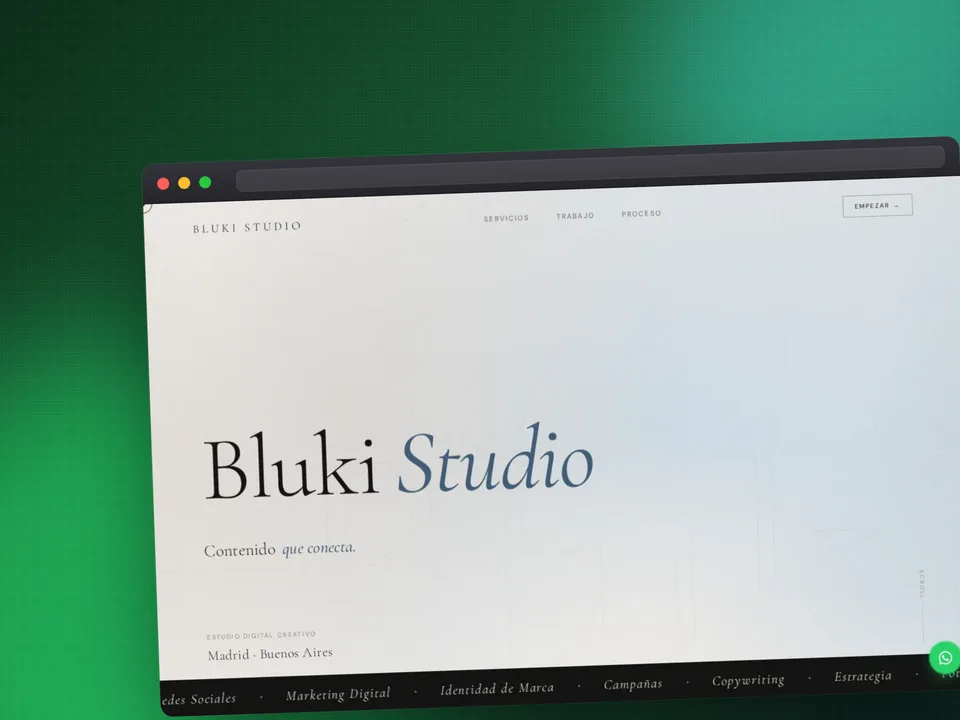
Bluki Studio is a creative digital agency portfolio built as a technical proof-of-concept for immersive 3D web experiences. The site centers on a single abstract 3D model, a petal-and-core sculpture, that reacts to scroll position in real time, rotating through three full turns and shifting across the screen as the user scrolls. The project explores a dual-layer rendering architecture where a fixed WebGL canvas sits behind a standard scrollable DOM layer, with both layers communicating through a shared mutable scroll state.
Objectives
- 3D Scroll Experience - Demonstrate a scroll-driven 3D animation where object position, rotation, tilt, and scale all interpolate smoothly across three keyframe sections.
- Performance-First Rendering - Keep the WebGL canvas at a stable 60 FPS using ACES filmic tone mapping, a capped pixel ratio of 2x, and ACESFilmic tone mapping configured directly on the renderer.
- Clean Architecture - Separate canvas and DOM concerns into distinct layers so future content sections can be added without touching 3D code.
- SSR Safety - Load all Three.js components via
next/dynamicwithssr: falseto prevent hydration errors in the Next.js App Router.
Project Workflow
- Scaffold and Config - Started from
create-next-appwith TypeScript and Tailwind CSS, then addedraw-loaderwebpack rules for GLSL shader imports and configurednext.config.tsaccordingly. - Lenis + GSAP Sync - Integrated Lenis smooth scroll with GSAP’s ticker to ensure
ScrollTrigger.update()fires on every animation frame, preventing scroll-driven animations from drifting. - Shared Scroll State - Created a lightweight mutable object (
scrollState) updated by both the Lenis callback and a native scroll fallback, readable insideuseFramewithout causing React re-renders. - 3D Scene Assembly - Loaded a custom Draco-compressed GLB model (
abstract_core.glb), auto-scaled it to a normalized bounding box, and remapped its materials by name: dark matte blue-grey petals and a glowing emissive core. - Camera Rig - Added a
CameraRigcomponent that pans the camera on the X axis opposite to the model’s lateral movement, doubling the perceived depth shift per section. - Lighting - Used a multi-directional soft light setup (hemisphere + three directional lights) to avoid specular hot spots on the metallic materials.
- Error Boundary - Wrapped the entire canvas in a React
CanvasErrorBoundaryso WebGL failures degrade silently rather than crashing the page.
Results and Impact
- Technical Foundation - Establishes a proven architecture pattern (fixed canvas + scrollable DOM + shared mutable state) that can be extended with additional sections, shaders, or post-processing effects.
- Smooth Animation - Scroll progress is independently lerped in both the model and the camera rig at different lag rates, producing a parallax-like depth effect without any additional geometry.
- Cross-Browser Stability - ACES filmic tone mapping and Intel/ANGLE-specific renderer flags resolve white blowout and color flickering observed on integrated GPU hardware.